There was a time when handing your camera to a stranger required a surprising amount of trust.
You’d get everyone together in front of whatever landmark you’d traveled to see, hand the camera over and hope the person knew what they were doing.
Click.
“Got it.”
Today, that same person will take six or seven photos, turn the phone sideways, take a few more and hand it back saying, “I took a bunch.”
Back then, there was no bunch.
If someone blinked or one kid made a face, you probably wouldn’t know until the vacation was over. You thanked the stranger and walked away.
And that picture cost money.
Taking a picture used to require a tiny calculation that’s almost completely disappeared:
Is this worth one?
Every Picture Had a Cost
A roll of film gave you 24 or 36 exposures. A disposable camera came with its own countdown. Every turn of that little plastic wheel brought you one picture closer to the end.
That didn’t mean every picture was carefully considered. Kids could burn through half a disposable camera taking terrible pictures of each other before an adult noticed.
But you knew there was a limit.
Whatever film you brought on vacation or disposable camera you took to camp had to last until you came home. If there were six pictures left and three days to go, you started rationing.
Then you had to develop them.
You paid for the film, paid to have it processed and paid for the prints. Families sometimes ordered doubles because sharing a photograph meant giving somebody an actual photograph.
Taking 40 pictures to get one good one wasn’t an option for most people. Forty pictures was more than a roll of film.
You Couldn’t Check the Picture
After you pressed the shutter, nothing happened.
There was no screen on the back of the camera. You couldn’t check whether someone blinked, the flash worked or your finger had wandered into the frame.
“Did you get it?”
“I think so.”
That was often the best answer available.
Candids worked differently, too. The person being photographed didn’t immediately ask to see the picture. Nobody reviewed it and decided to recreate the spontaneous moment because they didn’t like their expression.
A candid could catch something great or someone halfway through chewing, and nobody knew which until later.
Getting the Pictures Back Was Part of It
Eventually, the roll came out of the camera and went to be developed.
Then you waited.
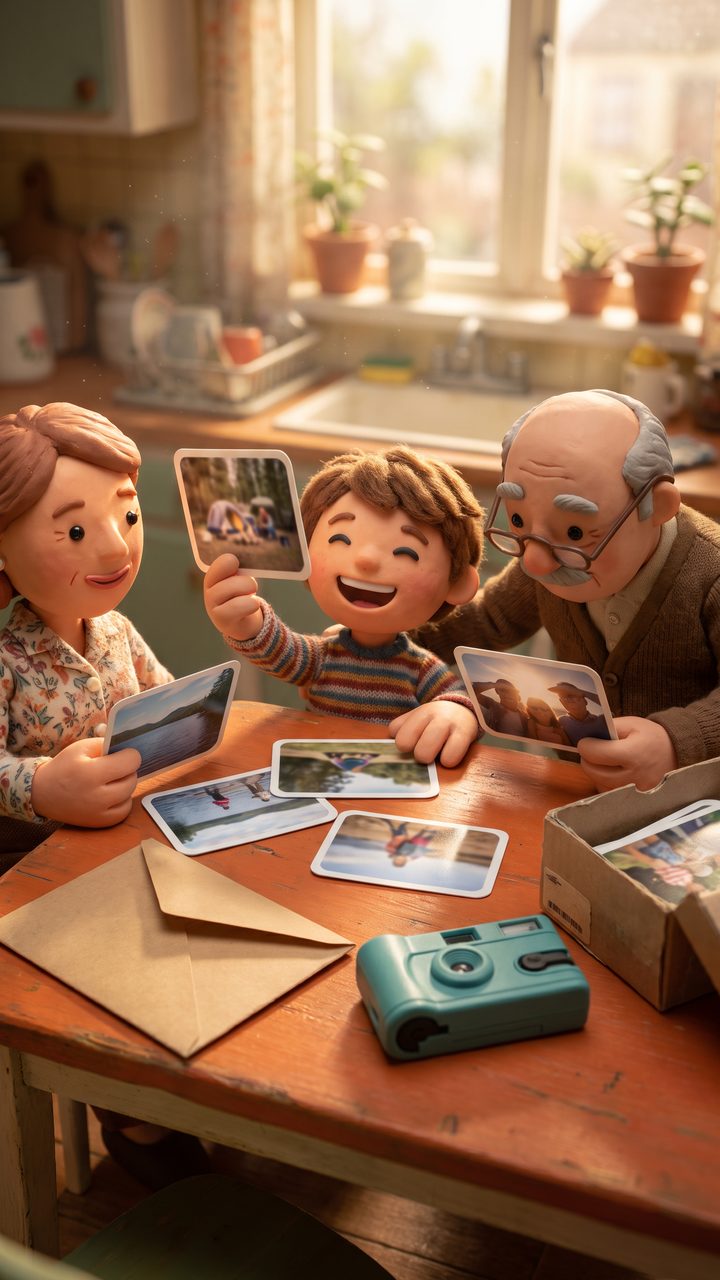
When the envelope came back, the pictures hadn’t already been seen, approved and shared. For the people who had been there, this was the first time they were seeing them too.
The prints got passed around as everyone figured out what they were looking at: the camping trip, spring break, that week in France.
There were good ones, blurry ones, red eyes, pictures nobody remembered taking and the occasional shot that made everyone ask who had been trusted with the camera.
A vacation could be over for weeks before you found out what the pictures looked like.
Now we usually see them before we’ve left the place where they were taken. Someone doesn’t like the first one, so you take another. Then another. Everyone checks. Everyone approves. You move on.
Sometimes the Bad Picture Became the Picture
There might be one photograph of everyone together.
If someone looked ridiculous, that didn’t necessarily send the picture to the trash. It might still go into the album. It might get framed. It might become the picture everyone remembered from the trip.
There just weren’t 15 nearly identical alternatives sitting beside it.
A few photographs could end up representing the whole thing: the family picture from a vacation, the kids at the campsite or everyone squeezed around the table at Christmas.
Those weren’t necessarily the best moments from the day. They were the moments someone happened to photograph.
There Was an Album or There Was a Box
Once the prints came home, somebody had to do something with them.
Organized families put them in albums. Prints went into plastic sleeves or were held in place with photo corners. Some people turned the whole thing into scrapbooks. Favorites went into frames, wallets, refrigerators or the edges of mirrors.
Everyone else had boxes.
Envelopes from the photo counter accumulated in drawers and closets. Loose prints migrated into shoeboxes. Years later, somebody would pull one out and have no idea when it was taken.
Which is why people wrote on the backs.
Camping, Summer ’89
Mom, Dad and Grandma
A photograph couldn’t tell you when it was taken, where it was taken or who was standing in it. If somebody wanted that information to survive, they had to add it themselves.
And sometimes you still look at that photograph and wonder what the hell was on Joey’s head.
Decades later, a few words in ballpoint pen can be the only reason anyone knows who they’re looking at.
Before There Was 23andMe, There Was a Slideshow
The lights went off, the projector came out and someone explained the family to everyone else.
That’s your grandmother before she met your grandfather.
That’s the house they lived in.
That’s your uncle when he still had hair.
The same thing happened with albums pulled from shelves or boxes dragged out of closets. Younger relatives knew the faces they recognized. Someone older filled in the rest.
The photographs gave people a reason to tell the stories attached to them: who everyone was, where they were living, why they were there, what happened to them later.
Eventually, the projector disappeared. The person who knew every name might have disappeared too.
But the slides and prints remained.
Hopefully somebody wrote on the back.
Then Taking Another Picture Became Free
Digital cameras loosened the limit first. Memory cards held hundreds of pictures, and a bad shot could be deleted immediately.
Then cameras moved into phones.
Now taking one more picture costs essentially nothing, so we use photographs for things that never would have been worth an exposure.
We photograph where we parked, receipts we might need, things we’re considering buying, serial numbers, restaurant menus and the dog sleeping in a weird position.
Most of those pictures aren’t meant to last. They don’t have to.
And the photographs we do want to keep are different too. A parent can take 30 pictures on an ordinary Saturday morning without wondering whether Saturday morning deserves 30 pictures.
Film made that kind of documentation impractical.
Fewer Pictures Also Meant Missing Things
It’s easy to make the old system sound more meaningful simply because it required more effort.
It also meant fewer pictures existed.
Cameras weren’t always around, film ran out, and plenty of the pictures people did take came back blurry. Huge stretches of ordinary life passed without being photographed at all.
Phones changed that.
The birthday and Christmas pictures still exist, but now so does the random Tuesday afternoon: the kid asleep sideways on the couch, the ridiculous breakfast or the ordinary room nobody thinks is worth photographing until 30 years later, when nobody can quite remember what it looked like.
Those are pictures worth having too.
With film, you usually decided whether something deserved a picture before you took it.
Now you can take the picture first and figure out whether it mattered later.
There are old vacations that survive in 24 or 36 prints, including the one where someone blinked, a few blurry ones and one nobody can make sense of anymore. The rest spent decades in an album or a box until they became inseparable from the memory itself.
They weren’t selected from 1,400 pictures of the trip.
They were the pictures of the trip.