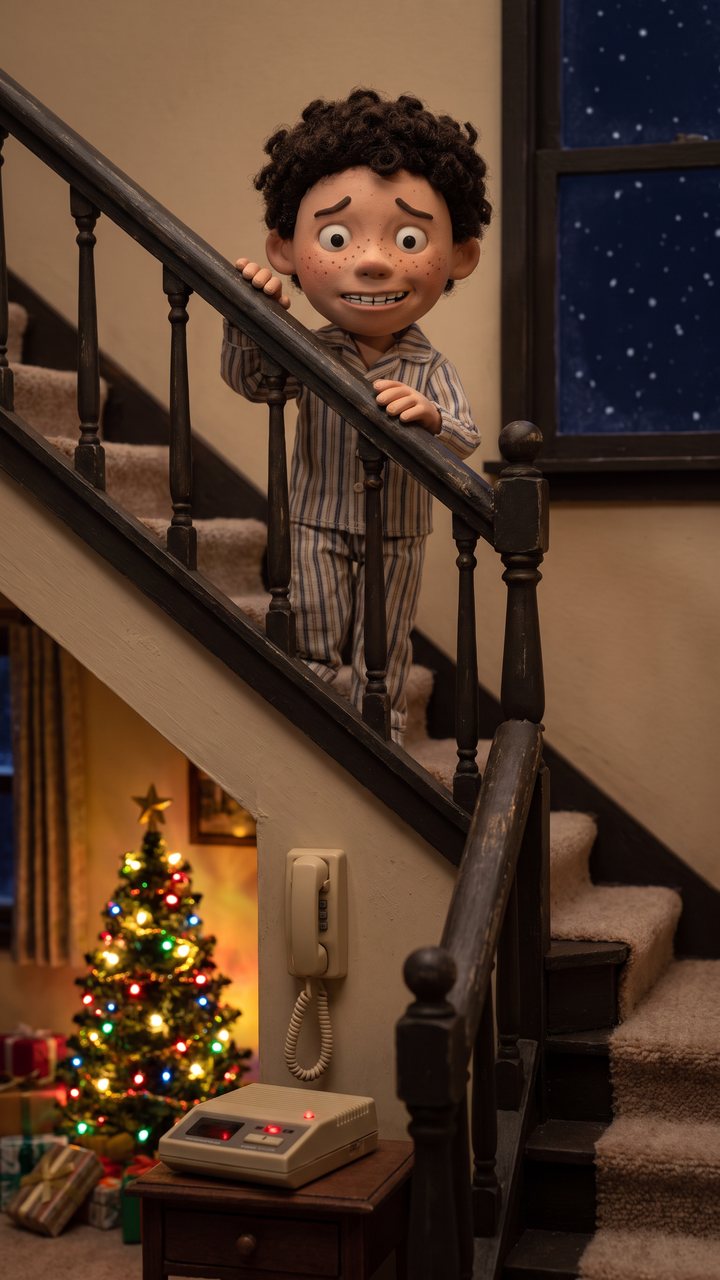
Made today, Home Alone might last five minutes. Kevin answers his watch. A doorbell camera catches his sled shooting down the front steps. Someone in Paris checks a shared location, and the missing McCallister turns out to be in Illinois.
Every December, the movie asks its audience to forget those possibilities. The family runs through the airport. The plane leaves. Kevin wakes up in a house that belongs to him.
The bargain gets easier with familiarity. Everyone knows where the milk spills, which ticket goes into the trash and when Kevin’s mom sits upright on the plane. There’s time to notice everything around those moments: the tiled kitchen counter, Fuller’s Pepsi, the patterned wallpaper behind a telephone that can ring without reaching anyone.
Released in 1990, Home Alone doesn’t need to explain any of this. These are ordinary things in an extraordinary story. Decades later, they help make pressing play feel like arriving somewhere.
Leave a Message After the Beep
Kevin’s mom knows the number. She knows the address. Neither gets her a conversation with her son.
The telephone belongs to the house. Reaching someone means reaching a place where that person might be, at a moment when they’re willing or able to answer. The neighbors have houses and numbers too, but many are away for Christmas.
The adults split up to call everyone they can think of. One returns with “nothing but a bunch of answering machines.” Somewhere between the airport pay phones and the empty houses back home, every attempt ends at a recorded greeting.
At home, automatic timers switch on the lights. Kevin’s dad considers them security. Harry considers them a schedule. He sits in the van and watches the houses light up, knowing nobody is inside.
The same separation makes Kevin’s predicament possible. A house can look occupied and be empty. It can look secure and contain a frightened child. Nobody can open an app and settle the question.
Pay Phones and Paper Tickets
Before departure, the important documents are on the kitchen counter, close enough to the pizza and milk to become part of the cleanup.
A paper ticket can disappear into a trash can. There’s no copy waiting in an inbox or boarding pass saved on a phone. Getting to Paris means keeping track of the paperwork as well as the children.
Uncle Frank has travelers checks. Kevin’s parents have cash for the trip. Before the family leaves Illinois, there’s already a discussion about whether Frank’s chosen form of money will work in France.
Overnight, the power goes out and the bedside alarm clocks reset. There’s no phone on the nightstand with a battery and a second alarm. Morning begins when Kevin’s parents stand and scream. Bags and children pour into the airport vans while Kevin sleeps upstairs. By the time the family reaches the terminal, “Run Rudolph Run” is playing.
The airport feels open in a way that can startle a contemporary viewer. The McCallisters move through it as a disorganized crowd, pleading for the plane to wait. The children scatter into available coach seats while the adults settle into first class.
Home Alone predates TSA. Making the flight depends on speed, luck and a gate agent willing to wave a family onward.
The kids are in coach, having the time of their lives. Up in first class, Kevin’s dad is sure of it. Uncle Frank is more concerned with getting the airline’s crystal into Aunt Leslie’s purse.
The Silver Tuna
Harry and Marv look at the McCallister house and see the silver tuna. Stereos. VCRs. Jewelry. Cash. Harry lists the possibilities. Marv just wants to know about the toys.
The McCallisters have the expensive version of everything that now turns up at a yard sale. Big televisions, a stereo with separate components, a VCR worth stealing. Harry sees a fortune. A phone can do most of it now, but seeing it all again can still make a room look better with a cabinet full of electronics.
The kitchen counter has tiles and grout lines. Red and green extend beyond the Christmas decorations into the furnishings themselves.
The master bedroom and the tucked-away beds on the third floor look familiar even to viewers who never lived in a house that big. Wallpaper, heavy curtains, patterned bedspreads: relatives still have rooms like these. In Home Alone, nobody has redecorated.
Did Anyone Order a Plain Cheese?
Fuller holds a Pepsi can that still looks like a Pepsi can, just not the one in stores. The old logo barely registers until it appears beside his enormous glasses. Then it’s a can from somebody’s childhood kitchen.
The Little Nero’s bill preserves more than the price. “A hundred twenty-two dollars and fifty cents, plus tip.” “For pizza?” “Ten pizzas times twelve bucks.” Nothing is prepaid. There’s no card saved in an app. Someone in that house needs to come up with the cash, and extra to tip the kid waiting at the door enough that he might not knock over the statue next time.
Kevin’s ice cream sundae gives being left alone a childhood-sized ambition: a tub of ice cream, all the toppings and nobody saying that’s enough chocolate syrup. There’s no need to order anything. Everything good is already in the kitchen.
Even his television requires something from the shelf. Angels with Filthy Souls goes into the VCR, where the same stretch of tape can be played until Kevin knows when to press the button. The gangster on the videotape becomes the adult at the door. For a kid surrounded by machines that mostly belong to grown-ups, knowing how to work one offers possibilities.
Did I Burn Down the Joint?
Kevin’s dad worries that someone will break a neck on the Micro Machines. Later, someone nearly does. The movie gets its traps from a childhood already underway in the house, complete with toys left out and projects that involve borrowing things nobody gives Kevin permission to use.
The glue gun and fish hooks get him in trouble before the family leaves. Outside, the treehouse gives him somewhere to go without leaving the yard. During the attack, a line from the house turns it into an escape route. The burglars follow him into territory meant for play.
That’s part of the world the movie keeps: children with territory beyond wherever the adults are sitting. A treehouse can be out of earshot. An older brother’s room can contain things worth sneaking in to see, including a Playboy that requires knowing where Buzz keeps it. The forbidden material has a hiding place, and its owner might come upstairs.
Kevin moves through that world in clothes that look chosen for a school picture: corduroys, knitted sweaters, a winter coat meant to keep him warm. Someone buys his clothes. He still thinks he can handle the house.
By the sequel, the Talkboy gives that confidence something else to work with. Recording a voice, changing its speed and playing it back can fool an adult. Between the two films, Kevin gets extraordinary mileage out of things children can recognize from their own rooms. December viewing keeps those possibilities intact, long after the toys disappear from the shelves.
Milk, Eggs and Fabric Softener
Kevin’s errand to the grocery store looks possible before it looks remarkable.
He buys “milk, eggs and fabric softener.” The last item suggests he’s doing more than keeping himself fed.
At the drugstore, he wants to know whether a toothbrush is approved by the American Dental Association. Shopping alone apparently comes with standards. Then Old Man Marley appears, Kevin panics and the toothbrush leaves the store in his hand.
The employee follows. Kevin is capable enough to shop alone and small enough to panic when an ordinary transaction goes wrong. Both fit inside the same child.
American children regularly spend time without adults during this period. Surveys count millions caring for themselves, especially as they get older. Later surveys document a decline in that arrangement as more children spend those hours under adult supervision and in after-school programs.
Letting himself in, finding food and working out what to do next are experiences some children get to rehearse. The film enlarges them until a kid draws a defense map and prepares the basement stairs for burglars.
It also preserves how easily his situation escapes attention. Kevin’s mom calls the police, an officer checks the house, and an unanswered door ends the visit. The film treats that failure as a brief comic obstacle. Kevin has to keep managing.
The freedom and the loneliness occupy the house together. He can choose dinner. He can’t make someone come home.
Macaulay Culkin
Kevin’s confidence can be borrowed from television, practiced in a mirror or deployed at a checkout. It can also fail when a room gets dark. Macaulay Culkin gives those shifts room to happen.
Culkin has to carry the movie much as Kevin has to carry the household. Most of the people who normally organize his day disappear. He has to fill the space they leave, and the performance allows that to be exciting, funny and frightening within the same afternoon.
Harry and Marv take cartoon punishment, but Pesci and Stern give Kevin something to act against. Harry isn’t charmed by the clever little boy. He’s furious that this kid is keeping him out of a house he intends to rob. His impatience and menace make Kevin’s fear believable, even when the next injury should require an ambulance.
Old Man Marley brings the same seriousness to the church. He listens to Kevin’s advice without treating it as an adorable thing for a child to offer. He has a son he doesn’t speak to and a granddaughter he watches from a distance. Kevin can help him while still being a frightened eight-year-old who wants his mom.
The premise is absurd; Kevin’s experience isn’t a joke. The adults give Culkin room to be thoughtful, angry or scared without turning every exchange into a setup for a cute answer. Children can take his predicament seriously. Adults have something to watch beyond a kid outsmarting two idiots.
The movie gives Kevin room to be capable without forgetting he’s eight. He can offer good advice, buy groceries and solve a problem, then get scared and want his mom. Those abilities need chances to develop. As more of childhood moves under adult supervision, there are fewer opportunities to find out what a kid can handle before someone steps in.
What a Funny Guy
By Christmas morning, Kevin has cleaned up enough for the house to receive its family.
They arrive with bags, coats and questions. He mentions buying milk, eggs and fabric softener. His dad laughs at the idea. “What a funny guy.”
The audience knows what else happens in that house. The family barely knows what to make of the groceries.
Kevin stands at the window and sees Marley with his family. Across the street, the conversation in the church becomes something he can watch happen. Then Buzz discovers his room, and the familiar household noise returns.
The movie keeps all of it ready for another December: the cash for the pizza, the cars on the floor, the unanswered phones. Kevin can still get into trouble without a notification arriving in Paris. He can still be frightened, resourceful and overlooked in the same day.
Every December, Kevin brings viewers back to 1990. His mom polkas her way home, the house is his, and a voice on a videotape still answers the door: “Keep the change, ya filthy animal.”