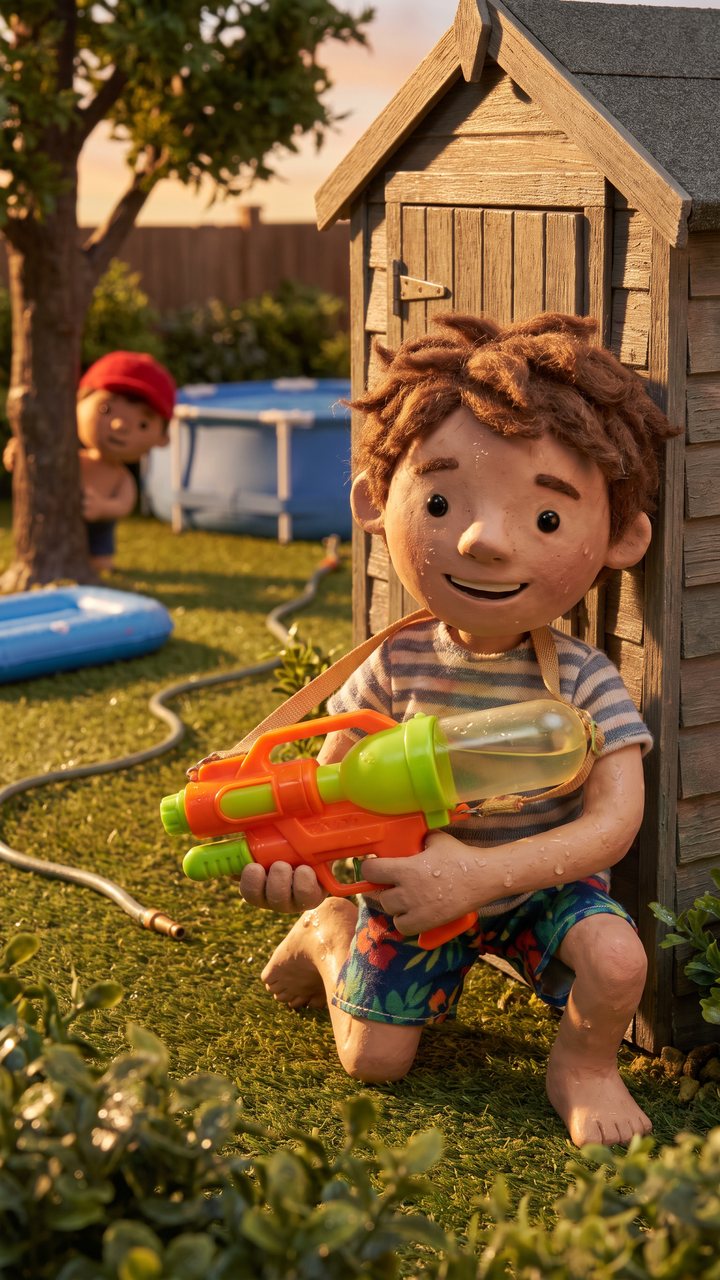
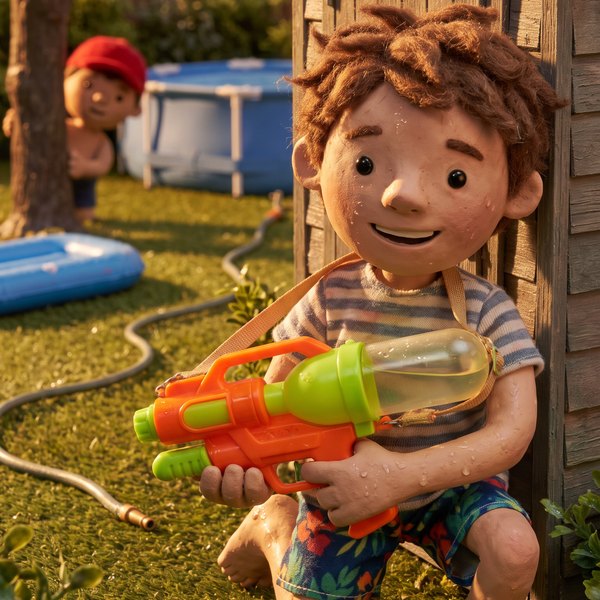
The shoulder strap dug in with a full tank. You could wade through the pool holding it above the water and be Charlie Sheen in Platoon. The ladder was right there, but that wasn’t how you came ashore.
Your brother waited somewhere beyond the inflatable raft. He had the same Super Soaker. Same tank, same pump, same chance of getting sprayed. Neither of you intended to make it a fair fight.
These things had carrying handles and shoulder straps. A full tank affected how fast a kid could run, which mattered when the person chasing had one too. Getting out of the pool meant hauling the gun onto the deck before climbing out beside it. The strap caught under an elbow. By the time everything was untangled, your brother was gone.
He would turn up. There was still water in his tank.
The Little Squirt Gun Was Finished
There was probably a transparent squirt gun in the garage, its stopper long gone. Filling it meant holding it under the faucet and plugging the hole with a thumb. It could wet a small patch of shirt if the other person stood close enough and cooperated.
Then someone brought out a Super Soaker. The yellow one with the green tank. Or the monstrosity with the purple pump that needed a shoulder strap. Your brother thought he was out of range. His shirt said otherwise.
The old pistol went to a younger sibling, along with an explanation that it was still good. The kid giving it away didn’t want it back. The rest of the afternoon involved finding out how far the new one could reach and whether the picnic table offered enough cover.
A shot could follow someone across the grass. Ducking behind a bike didn’t accomplish much. The person firing kept the trigger down while the person running reconsidered where to go.
Five, Ten or Twenty
A bigger Super Soaker could change the teams before anyone got wet. One friend arrived with two reservoirs. Another had water strapped to his back. The kid holding a small pistol wanted to know who was on his side.
The CPS 2500 had a choice to make at the front: 5x, 10x or 20x. Five kept you away from the hose longer. Twenty was for your brother. He could see you turning the nozzle, which gave him a head start.
The biggest setting sent out a thick rush of water and used up the pressure fast. It was worth saving until someone came close enough that missing seemed unlikely. Missing anyway meant working the pump while retreating around the garage.
Friends wanted a turn. They reached for the carrying handle and promised not to waste the water. You kept the strap over your shoulder. There was a reason they wanted this one instead of going home for theirs.
Back When Plastic Felt Like Plastic
The shell felt hard. The pump resisted. This was back when crushing an empty Poland Spring bottle took some effort. A full Super Soaker had weight to it, and setting it on the grass left a flattened patch underneath.
It spent afternoons beside the pool, got carried by whichever part was within reach and rode home across bicycle handlebars.
They broke, of course. A missing cap could end the fun. A leak could send more water down the owner’s shorts than toward anyone else. But scratches on the shell didn’t mean much. The thing could look like it spent a summer being dragged through the yard because it did.
By August, nobody needed the label to identify whose was whose. One had a twisted strap. Another leaked beside the trigger. Yours was the one your brother was holding, despite owning his own.
The Pump Meant Something
From the other side of the hedge came the pump sliding back and forth. Time to run.
That resistance in the handle came from storing up the next shot. The early Super Soakers used compressed air; the later Constant Pressure System used an expanding rubber chamber to keep a strong stream coming as it emptied. The letters CPS appeared on the side. Most kids cared more about what came out of the front.
The idea started with Lonnie Johnson, an engineer who worked on spacecraft. An experiment sent water shooting across his bathroom, suggesting another use for what he was building. Eventually, a kid could carry the result into a backyard and make everyone else run.
A full tank didn’t guarantee a useful shot. Forgetting to pump produced a dribble at the worst moment. Your brother saw it, stopped retreating and started walking toward you. The pump began moving fast. So did your feet.
The Hose Was Neutral Territory
Running out meant returning to the same place as everyone else. The hose lay across the driveway, surrounded by caps, puddles and kids who claimed they got there first.
The first water came out warm. Once it ran cold, someone held a tank beneath it while the next person offered advice about the angle. Water spilled over a wrist and into a sneaker. Filling went faster when everyone stopped helping.
Calling a truce to refill was supposed to provide protection. The gun was open, the cap was off, and defending yourself meant abandoning the refill. Most kids honored it until somebody gave them a reason not to.
Your thumb went over the hose opening. Suddenly, everyone believed in the ceasefire.
Then a parent’s voice came through the window. The hose went down, and everyone looked helpful until the window closed.
The Options Now Feel Like a Downgrade
Years later, a new water gun comes out of its package, and the size brings back some expectations. The tank looks big. The colors promise something. Outside, kids fill it and begin chasing each other.
Before long, someone approaches with a piece in their hand. An adult turns it over, looking for where it should snap back in. There’s another broken one in the garage awaiting the same inspection.
Even when everything stays attached, the shot can disappoint. Some newer water guns push out a burst with each stroke of the pump. The old CPS stored pressure, then released a stream until the chamber needed pumping again. Both arms working for every splash feels like a lot of effort when the memory involves holding a trigger and watching someone retreat.
Pressurized models still exist. But the size of the package and the name on the side don’t guarantee the same thing underneath. Picking one up can leave an adult searching for the weight, the resistance and the reason those old ones needed a strap.
One More Shot Before Dark
By late August, the sun slipped behind the houses before anyone was ready to go in. Towels hung over the deck railing. The driveway was drying in patches, and the hose lay where someone dropped it. There was still water in the tank.
Your dad’s car pulled in. You watched him get out, work bag in one hand, keys in the other. The pump slid back and forth while he shut the door.
He heard it. He knew.
The stream caught his work shirt before he reached the steps. He stopped, looked down at the wet patch, then looked at you. For a second, the next move belonged to him. He could come after you. He could reach for the hose.
You stood there grinning, finger on the trigger, with enough pressure left for another shot.
School would start soon. One afternoon, the Super Soaker would go into the garage and stay there. Nobody would know to mark the occasion.
For now, your dad reached for the hose as you pulled the trigger.