You didn’t always go to the mall because you needed something.
Sometimes somebody’s mom dropped you off at noon and agreed to come back at four.
That was the plan.
Four hours at the mall with no particular reason to be there. You wandered through stores, ate something at the food court, ran into people you knew and killed an astonishing amount of time considering how little you might actually buy.
Nobody considered the trip unsuccessful.
The mall was full of stores, but shopping was only part of what it was for.
You Could Go Without a Plan
There aren’t many places left where teenagers can spend several hours without being expected to accomplish anything.
The mall was built for it.
You wandered from store to store depending on what somebody wanted to look at next. Eventually everyone ended up at the food court, where five people could order from five different places and still eat together.
You saw people you knew from school and people you vaguely recognized from other schools. You might spend half an hour with somebody you hadn’t arrived with. Groups split apart and re-formed.
None of this required much coordination because everybody was already in the same place.
Even getting separated wasn’t necessarily a crisis. You had a meeting point.
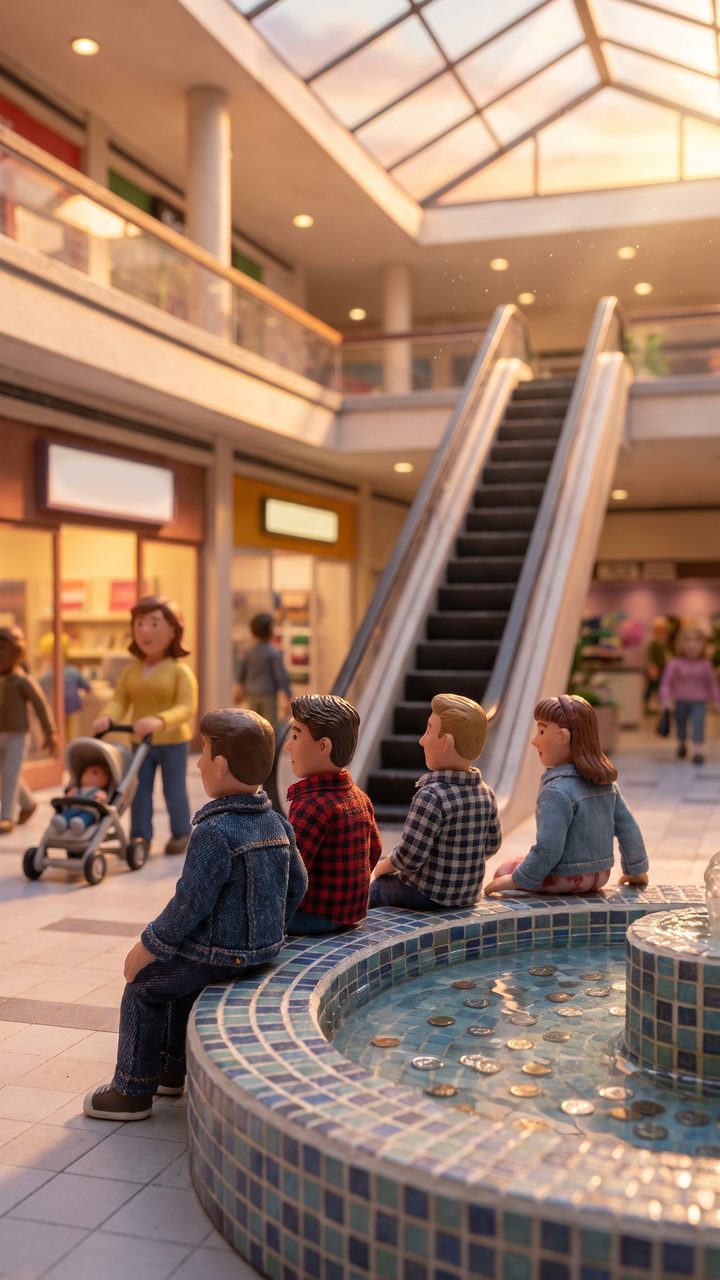
We’ll meet by the fountain at three.
And somehow, most of the time, everyone did.
Sometimes You Actually Had to Buy Something
Of course, people also went to the mall because they needed things.
Back-to-school shopping could take an entire afternoon. You tried on jeans, shoes and shirts while somebody waited outside the fitting room and offered opinions you hadn’t requested.
A wedding, job interview or school dance could require a trip specifically to find something to wear. If the first store didn’t have it, you walked to the next one.
There was no opening twelve browser tabs and comparing everything from the kitchen table.
Selection was limited to what was physically around you, but having so much of it under one roof meant you could spend an afternoon getting half a dozen errands done without going back to the parking lot.
Families could split up.
Dad could go look at power tools at Sears or decide he liked the way he looked at Men’s Wearhouse while Mom took the kids somewhere else. Everybody agreed to meet at a specific place at a specific time.
Being fifteen minutes late had consequences.
Nobody could text.
Christmas Turned the Mall Into Something Else
For a few weeks every year, the mall became Christmas headquarters.
The decorations went up, Santa arrived, garland hung from railings and Christmas music played everywhere. Temporary kiosks appeared in the walkways selling things nobody seemed to sell during the other eleven months of the year.
And the parking lot became war.
Christmas shopping meant going Christmas shopping.
Christmas presents required an actual shopping trip. Sometimes you knew exactly what you needed. Other times you walked around hoping the right gift would reveal itself.
You carried bags from store to store. If you were shopping with the person whose present you needed, you had to find a way to lose them. Parents hid bags from kids. Kids tried to figure out what was in the bags.
By December 23, the whole place felt mildly unhinged.
For all the hassle, Christmas shopping had become part of Christmas itself.
Adults Hung Out There Too
It’s easy to remember the mall as teenage territory, but adults used it just as casually. You might meet somebody for lunch, bring the kids when the weather was terrible or wander through a department store after dinner.
You could get a watch battery replaced, find a birthday present and eat a pretzel without moving your car.
That made the mall useful in a way that had little to do with any individual store.
The stores could change, but the reason to go remained.
It was a place where a lot of ordinary life happened at once.
The Food Court Was Its Own Destination
The food court solved a problem that still isn’t particularly easy to solve. Everybody could want something different and it didn’t matter. One person got pizza, somebody else got Chinese, another came back with a giant cinnamon roll that somehow counted as lunch, and you all found a table.
You usually stayed there longer than it took to eat. It was a place to sit, talk, watch people go by and figure out what you were doing next.
Eventually somebody would ask, “Where do you want to go now?”
“I don’t know.”
And that was fine too.
The Mall Gave Kids Somewhere to Practice Being on Their Own
For teenagers especially, the mall offered a small dose of independence. Somebody dropped you off and promised to come back a few hours later. Until then, you were on your own in a place that was public, busy and relatively contained.
You kept track of your money and, more importantly, the time. If your ride was coming at four, you had better be standing at the agreed-upon entrance at four.
For a kid who couldn’t drive yet, a few unsupervised hours at the mall could feel like a lot of freedom.
Shopping Got Much Easier
There was an obvious reason the mall lost some of its grip on everyday life: we stopped needing to go there.
Socks don’t require a Saturday afternoon anymore. Neither does finding a Christmas present in the right size. You can have almost anything delivered to your house, and even when you do drive to a store, half the time you don’t have to get out of the car. Order ahead, pull into a numbered space and somebody brings it to you.
That’s enormously convenient. It also removed a lot of the ordinary reasons people once ended up in the same place.
We Didn’t Just Stop Shopping There
Plenty of malls still exist. Some are busy. Some have reinvented themselves around restaurants, entertainment, gyms and experiences. Others have lost their anchors, emptied out or disappeared entirely.
But the old mall depended on millions of ordinary reasons to leave the house. Once enough of those errands could be handled somewhere else, there were fewer reasons to go.
As those reasons disappeared, so did some of the people who used to fill the place: teenagers wandering around with twenty dollars, parents pushing strollers, friends meeting for lunch and somebody sitting on a bench because the rest of the family was still shopping.
What mattered was that all of those people, doing completely different things, ended up in the same place.
The mall wasn’t just where you bought things. It was somewhere to go.